Curl Technique: Make the Repetition Count
By Derrick Inglut
If your back is doing most of the moving during a curl, the weight may be getting more attention than the muscle you intended to train.
That was the point of my original biceps column. A useful repetition is one you can repeat with a consistent setup—not simply one in which the dumbbell reaches the top.
Set up before the first repetition
Choose a load that allows you to stand or sit steadily. Keep your wrists in a comfortable position and avoid turning the start into a hip drive. Move through a range you can control without pain.
There is no need to force the elbow into an uncomfortable end position. Equally, shortening each repetition as the weight gets heavier makes it harder to compare one set with the next.
Choose support when it helps
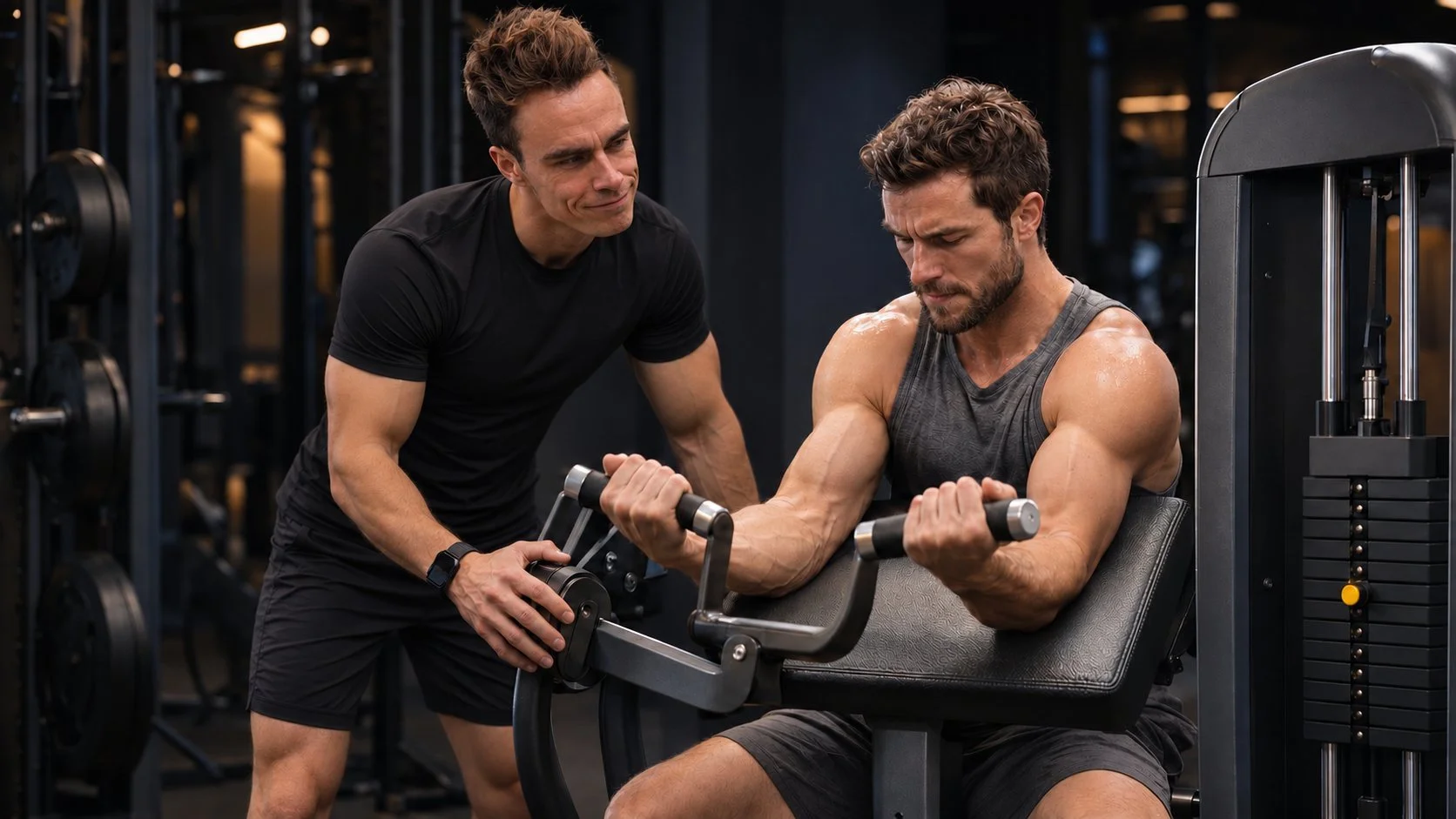
A seated curl can reduce the temptation to rock your body. A preacher bench provides another kind of support, but its setup should fit your arm length and the equipment. “Set the seat as low as possible” is not a universal rule.
Try the movement with a light load before committing to the work set. If the position feels awkward, use a different variation rather than making the support itself the challenge.
Control the return
Lower the weight deliberately. If it drops as soon as the lifting phase ends, reduce the load and practice the return.
Read Negative Training: A Smarter Way to Lower the Weight for the difference between ordinary eccentric control and advanced overloaded work.
Record a fair comparison
For your next few sessions, keep the exercise and setup consistent. Write down the weight, repetitions, and whether technique stayed recognizable. Add difficulty gradually when the existing work is manageable.
For bodybuilding goals, curls can provide focused arm work within a broader program. They do not need to replace pulling exercises or turn every set into a maximum-effort test.
If elbow or shoulder pain keeps returning, stop trying to solve it with a more elaborate curl and seek an appropriate assessment. The goal is to make the exercise serve you, not to win an argument with a particular dumbbell.
If you already train consistently but your progress has stalled, explore my advanced personal training in Washington, DC. We can examine your technique, progression, and overall program to give your next training block a clearer purpose.
Adapted and updated from “Pro Biceps Training,” originally published in The Southwester, October 2011, p. 8.